Lesson inspiration: some easy ways to engage your learners
Mohammed Rayhan
Teacher Mohammed Rayhan shares how keeping a digital diary of everyday photos can inspire creative, engaging IELTS lessons and spark learner discussion.
Think about the times you were thinking of how to start your lesson while you were driving, or walking on your way to the classroom. It has become a norm for me to keep my digital diary up-to-date with photos, notices, signposts, or unusual objects that can be used in my creative writing or even in the lesson. I have to say, these days, I tend to use my digital diary a lot.
This habit of keeping a digital diary started when I was a full-time teacher at the British Council, Dhaka. I was involved with the young learners, who were super spirited, and to keep them engaged, you must come up with very creative, interesting, and competitive ideas.
What is needed
I am lucky to have a Canon EOS D550 with a Zoom lens. I take close-ups of objects, anything that would cause a stir among my learners to debate, to write about, to research, to present, or as a warmer to steer them to the topic of the lesson.
You don't need to be a serious photographer or have a specialist camera. Some of the smartphones nowadays have much better photo options than my Canon 550d. You just need your smartphone.
What to record
Honestly, absolutely anything. Whatever you find something exciting and interesting, record it.
I live among the farmers here, and often I find the warning posts to the dog walkers, or a small bookbox outside a café, or farming tools left here and there, or the change of the season, or the flora and fauna that change with the seasons. They all come in very handy in my lessons.
You will always find something that inspires you, while walking, chatting, on the buses or trains, or even the chat you overheard while minding your own business. Write them in your memos and post on the projector to probe your learners' reactions. I remember the time when I used to take photos of the 'Poems on the Underground' in London. They were absolutely brilliant!
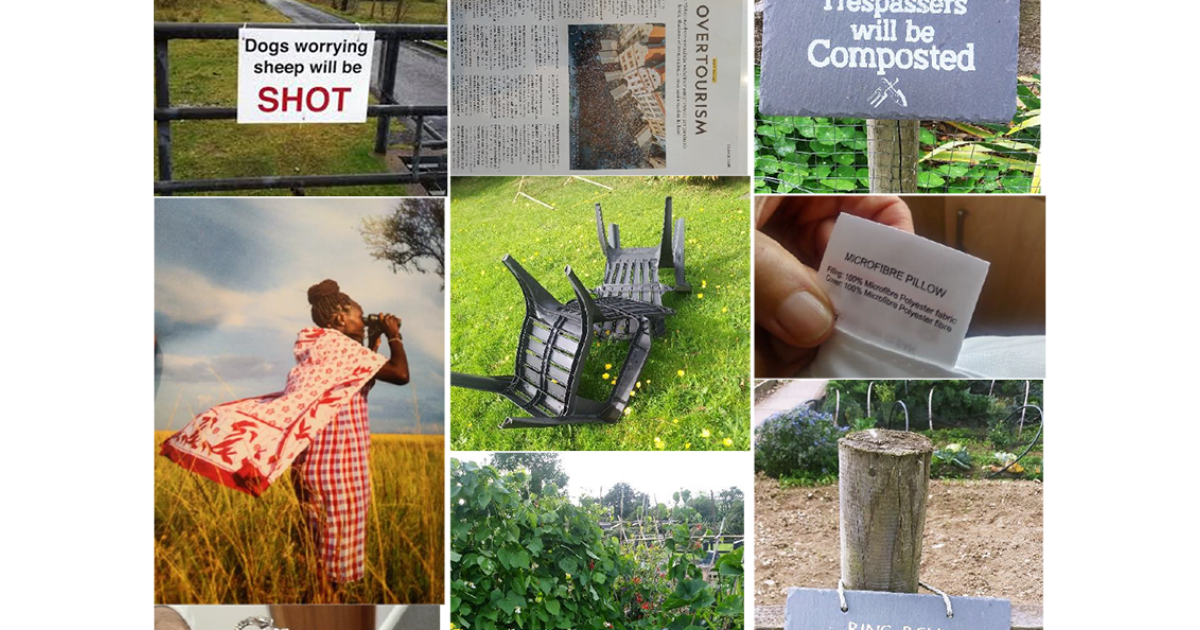
Here are some examples of my digital diary
One of the examples that I used was a sign that says Dogs worrying sheep will be shot. I explored the punctuation rules and word stress in the sign, and had a discussion on the ethical side of the sign.
Here are more photos that I used while I was teaching – from a simple sign saying the above to a comical and an obscure sign in a garden centre that says Trespassers will be composted.
Remember, technology is here to help us to be creative teachers, and I learnt from Nick Peachey, a pioneer in EdTech, that a simple phone with a camera can be a useful life-saving tool in the classroom when we utilise its full potential correctly.
It doesn't take that long to make your lesson engaging. Keep your eyes open and record when you see something unusual and interesting. The following images are some of my favourite ones that I used in my lessons, and I still use them. See what you can do with them – be creative.
How to incorporate them into your lessons
I normally use them to stir a debate, or an open class discussion, as a warmer, or to have an in-depth analysis of the topic for developing a paragraph in IELTS writing.
Further research into the topic as homework keeps my learners engaged for a week or two, depending on the tasks.
These days, I ask them to create an infographic related to the topic – a digital poster replacing my old-style posters, more suited to today's tech-savvy learners.
Some general tips
Make your lessons relevant and somehow connected to what you experience in your everyday life.
Ask your learners to think deeper: why would someone put the chairs in that formation on the lawn, or what would be the purpose of having weird jewellery?
The hospital infographics – let them turn that into an automated voice recording – this would certainly help them to develop your learners to record a 2 minute monologue, using various sign-posting phrases, which can be used to illustrate an example of IELTS writing task 1 (process writing).
Asking your learners to create TFNG questions from the magazine article would certainly hone their reading skills to another level.
By the way, the photo of two chairs in the garden is from my garden and as a warmer, I would ask my learners if they want to sit there and why?
Final thoughts
Simplicity is the key here. You start simple, and then slowly, based on the responses you get from your learners, you can extend in various ways. For example, what significance do the chairs bring to the garden, and why is being close to nature a calming factor for our minds and so on.
One final tip. Review your digital diary from time to time and refine your photos with comments, how you felt when you were taking the photos, and what your initial thoughts were, and after utilising them once, add your reflections on what you would change in the future if you use them again.
The only snag is that I need to get another phone with a bigger memory. Too many photos.