Idiomatic English in Britain and America
Sona Lisa Bose
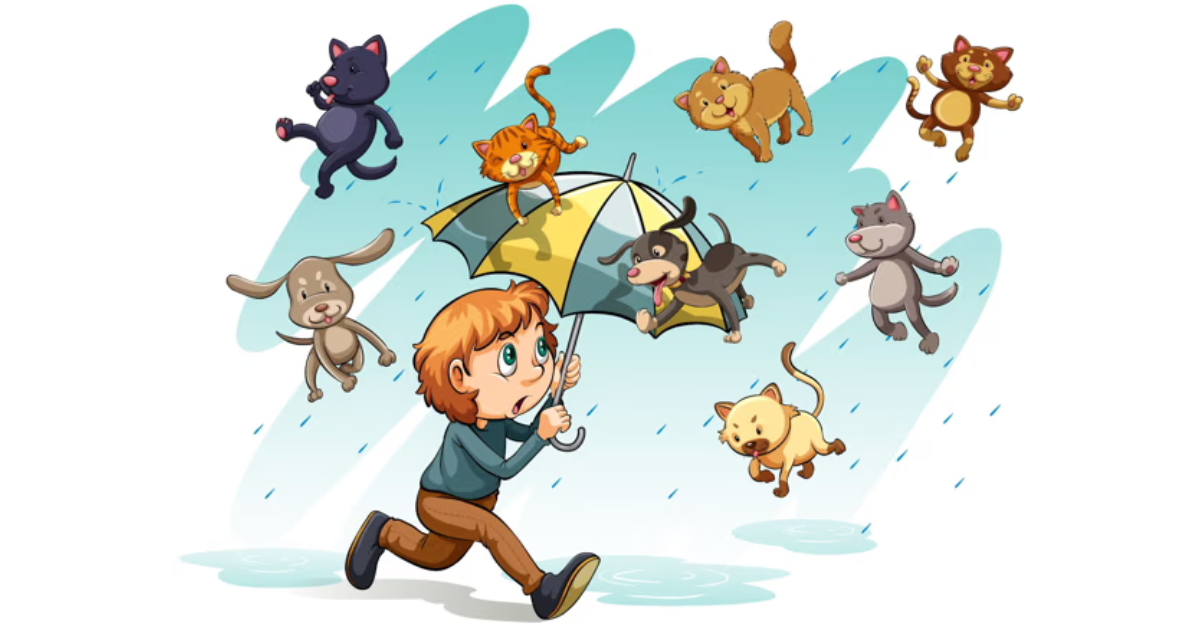
In my last blog post, I looked at variations in everyday English used in the workplace in Britain and America. In this blog post, I look at differences in the kind of idiomatic English used on both sides of the Atlantic. When you’re studying English, your teacher may well give you some useful phrases that we use in more informal situations, such as the expression, “it’s raining cats and dogs”, which means that it’s raining very heavily. Well, this is an idiom. An idiom is a phrase that doesn’t literally mean what it says. So in the case above, there are no actual cats and dogs falling from the sky. Idioms are of course quite culturally specific, so some of them just don’t translate well between English speaking countries. Let’s look at some of the funnier ones from Britain and America. How many do you know?
In my last blog post, I looked at variations in everyday English used in the workplace in Britain and America. In this blog post, I look at differences in the kind of idiomatic English used on both sides of the Atlantic.
When you’re studying English, your teacher may well give you some useful phrases that we use in more informal situations, such as the expression, “it’s raining cats and dogs”, which means that it’s raining very heavily.
Well, this is an idiom. An idiom is a phrase that doesn’t literally mean what it says. So in the case above, there are no actual cats and dogs falling from the sky.
Idioms are of course quite culturally specific, so some of them just don’t translate well between English speaking countries. Let’s look at some of the funnier ones from Britain and America. How many do you know?
Idiom | British or American? | Meaning |
Give me your John Hancock | John Hancock signed the American Declaration of Independence, so his signature is very important. When an American says, "Give me your John Hancock" it means, "I need your signature." | |
A fanny pack | Be careful, because this really doesn’t translate into British English well! It has a slightly rude meaning and will leave all Brits tittering (laughing because someone has said something naughty). In American English, it’s a belt you wear around your waist which has a little pouch attached where you can keep your passport, wallet, etc. In Britian, we’d call it a "bum bag" and the word "fanny" has a very different meaning indeed! | |
I’m chuffed to bits | This is something Brits say when we are very happy that something has gone right for us. For example, you could say to your friend, "I’m chuffed to bits - I’ve got a band score 7 in my IELTS!" It basically means: "hooray!" | |
Let’s have a butcher's | This comes from old Cockney rhyming slang, which works on the basis that we substitute the word we want to say for a word which rhymes with it. So "strife" (meaning a "problem") rhymes with "wife", so the expression "my trouble and strife" is a humorous way of saying, "my wife!" Confused? So are most non-Brits! And wait, it actually gets worse. We sometimes leave out the rhyming word completely. So when we say, "let’s have a butcher’s", we mean "let’s have a butcher’s hook" - or - "let’s have a look!" So when your British friend is sitting next to you on their phone, laughing at a cute video of a cat, you can say to them, "let's have a butcher's" and they should pass their phone to you so you can see the video too. | |
Gordon Bennett! | This means, "oh my goodness!" Gordon Bennett was a journalist who did lots of outrageous things in his life, like publish the equivalent of tabloid "kiss-and-tell" articles. His son, Gordon Bennett Junior, wasn't much better, and spent the family multi-million-dollar fortune in a lavish playboy lifestyle around the world. So when we say "Gordon Bennett", we mean we are really shocked by something. Although a British phrase, Gordon Bennett was actually American. | |
Fancy a chinwag? | Your "chin" is the lower half of your face, and "wag" is like a dog wagging its tail, so this kind of makes sense. If your jaw is moving a lot - like a dog wagging its tail - it means you're talking a lot. And a "chinwag" is a good catch up with a friend where you can sit and relax and gossip and generally chat about all the things friends chat about. | |
Jump the shark | This refers to an American sitcom called "Happy Days" which used to be really popular in the 1970s. However, as time went on, it became less and less so, and the makers wanted to get more people to watch it again. So, they decided to have the main character, a guy called Fonzie, literally get onto a jet ski and jump a shark. But most fans thought this was a step too far. The show was deemed to have passed its peak, and the makers were trying desperately to make it fun again, but it was too late. So if a show has "jumped the shark", it’s a last ditch attempt to pull in more audiences, but really, it's not working. The show is over. | |
Oh my days! | This is an alternative to "Oh my God" or OMG. It's an old phrase that used to be associated with god fearing respectable old people, but it has become fashionable among British youth in the last decade or so. | |
I can’t even | Here, we've got another example of an unfinished sentence! You can complete this with … “I can’t even imagine / begin to think…” and it normally shows that you are overwhelmed by something. |
These idioms are just a selection of the differences we can find between British and American English.
If you want to learn some colloquial idioms yourself, the best way is to pick a specific subject - e.g. the weather - and research some specific idioms for that subject. Be selective. Think about who you'll be talking to (Americans, Brits, non-natives) and use the idioms you learn carefully. We don't use idioms all the time, we just tend to slip phrases into conversation from time to time. It’s more important initially that you learn to understand their meaning, rather than try to use them yourself. That will come in time. Idioms tend to be something you just "pick up" along the way.